Category: Uncategorized

  • Influencer Box Inserts: Molded Pulp, Foam, and Corrugated Compared

    Influencer Box Inserts: Molded Pulp, Foam, and Corrugated Compared

    Everything a brand agonizes over on the outside of an influencer box, the foil, the color, the magnetic closure, is undone in half a second if the creator opens the lid to find the product rattling loose in a nest of shredded paper. The insert is the part of the box that does the quiet work: it holds the product still through a rough courier network and it stages the reveal for a camera that is already rolling. Those are two different jobs, and the four common insert materials trade them off very differently. Here is how they compare when the box is a PR or seeding unit rather than a shipping carton.

    The insert has two jobs, not one

    A retail shipping insert only has to get the product there intact. A PR insert has to do that and land the first impression, because the moment the box opens is the content. That raises the bar on presentation, on how the product is angled toward the opener, and on whether the interior reads as considered or cheap. It also raises the stakes on protection, because a cracked compact or a leaking serum photographs terribly and quietly kills the post you paid to seed. Pick the material that satisfies whichever of those two jobs is your real constraint, then make it acceptable on the other.

    Corrugated die-cut: the printable workhorse

    Die-cut corrugated inserts, cell dividers, pads, and cradles are the most economical option and the easiest to brand, since corrugated takes print well and can carry color or a message on the insert itself. The tradeoff is that corrugated holds and organizes rather than cushions. It is excellent for kitting several items into fixed positions and for keeping a flat-lay looking intentional, but it is not a shock-absorber for anything genuinely fragile. Lead times are short, commonly in the range of seven to fourteen business days, and it is fully curbside recyclable, which makes it the default for multi-item seeding kits of durable goods.

    Molded pulp: the sustainable presentation choice

    Molded pulp, or molded fiber, forms a custom cavity around each item from what is typically 100% recycled paper. It comes in grades from rough thick-wall through transfer-molded and thermoformed versions with one or both faces smooth, so you can choose how refined the finish looks. It cushions better than flat corrugated, it is curbside recyclable and compostable, and it has become the standard swap for brands trying to get plastic and foam out of a box. The two costs to plan for are a mold, which adds upfront tooling and pushes first-order lead times into the three-to-five-week range, and surface texture, which limits high-definition printing on the insert. The chart below places it against the alternatives on the two axes that usually decide a PR box.
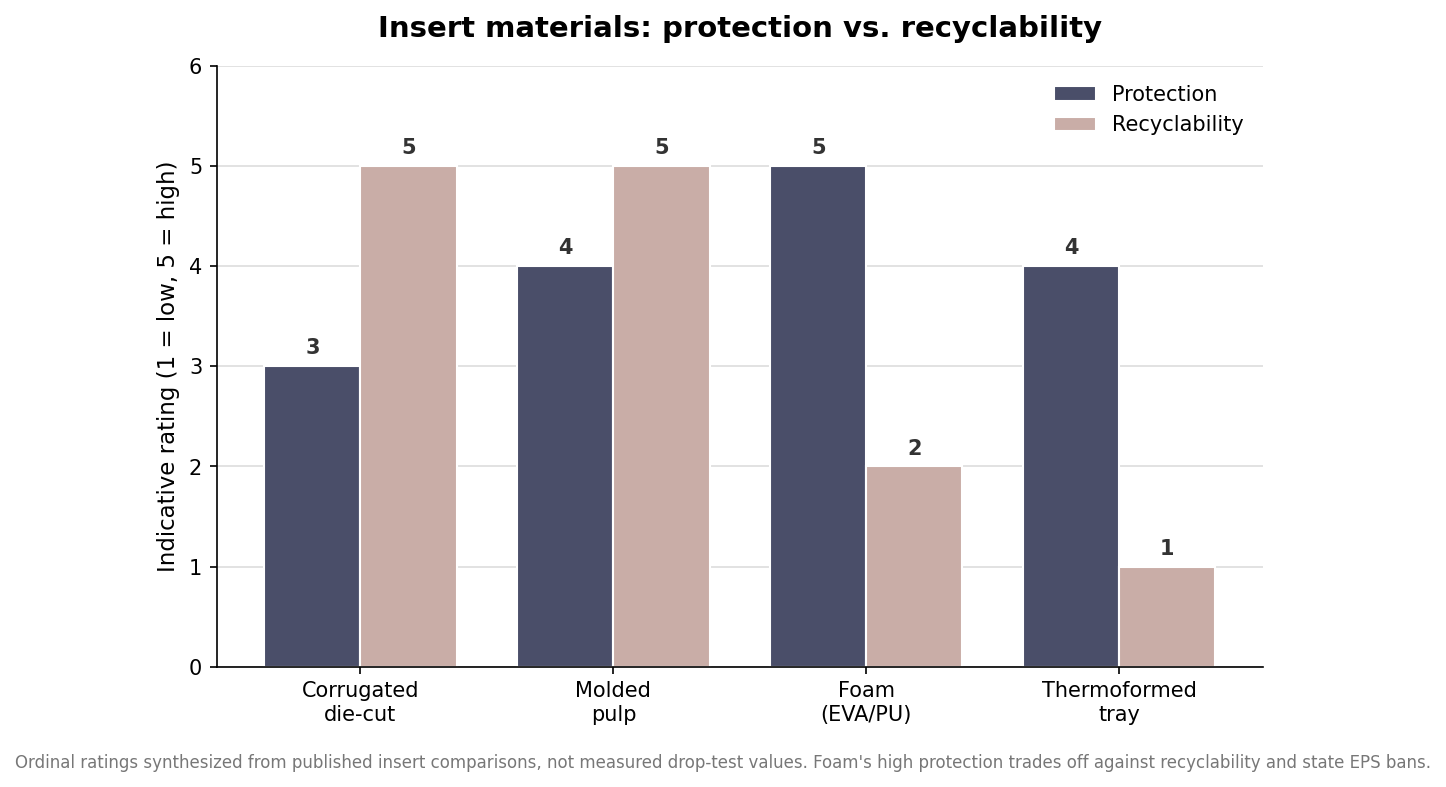
    Grouped bar chart rating corrugated, molded pulp, foam, and thermoformed inserts on protection and recyclability from 1 to 5
    Foam protects best but rates worst on recyclability; molded pulp balances both.

    As an indicative figure, custom molded-pulp inserts often land around a dollar per unit at retail-facing volumes, though real pricing swings with cavity complexity and quantity, so treat that as a planning number and get a volume quote.

    Foam: maximum protection, minimum print

    Die-cut foam, whether flexible EPE, rigid EPS, or precision polyurethane, wins outright on shock absorption and is the right answer for genuinely fragile or high-value electronics. For an influencer box it carries three real drawbacks. Foam prints poorly, so it rarely looks premium on camera unless it is hidden under a tray. It adds bulk that increases dimensional-weight shipping charges. And expanded polystyrene in particular is now banned from disposal in several states, including California and New York, which turns a foam insert into a sustainability liability that beauty and lifestyle brands increasingly cannot defend. Reach for foam when the product will genuinely break otherwise, not by default.

    Thermoformed trays: the retail-slick option

    A thermoformed plastic tray gives the crisp, product-hugging look of premium electronics or cosmetics packaging and holds items dead still. It suits high-volume runs because the tooling cost is significant and only amortizes across large quantities, and its lead times sit alongside or beyond molded pulp. The catch is recyclability: most thermoformed trays are not curbside accepted, so the same tray that looks the most expensive is often the hardest to square with a sustainability message. It is a strong choice for a large, polished launch and a poor one for a small eco-positioned seeding wave.

    Match lead time to your seeding calendar

    The material you can afford is often less of a constraint than the calendar. Corrugated can turn around inside two weeks; anything molded, whether pulp or thermoformed plastic, needs tooling built before the first unit exists, and that step is where launch timelines slip.
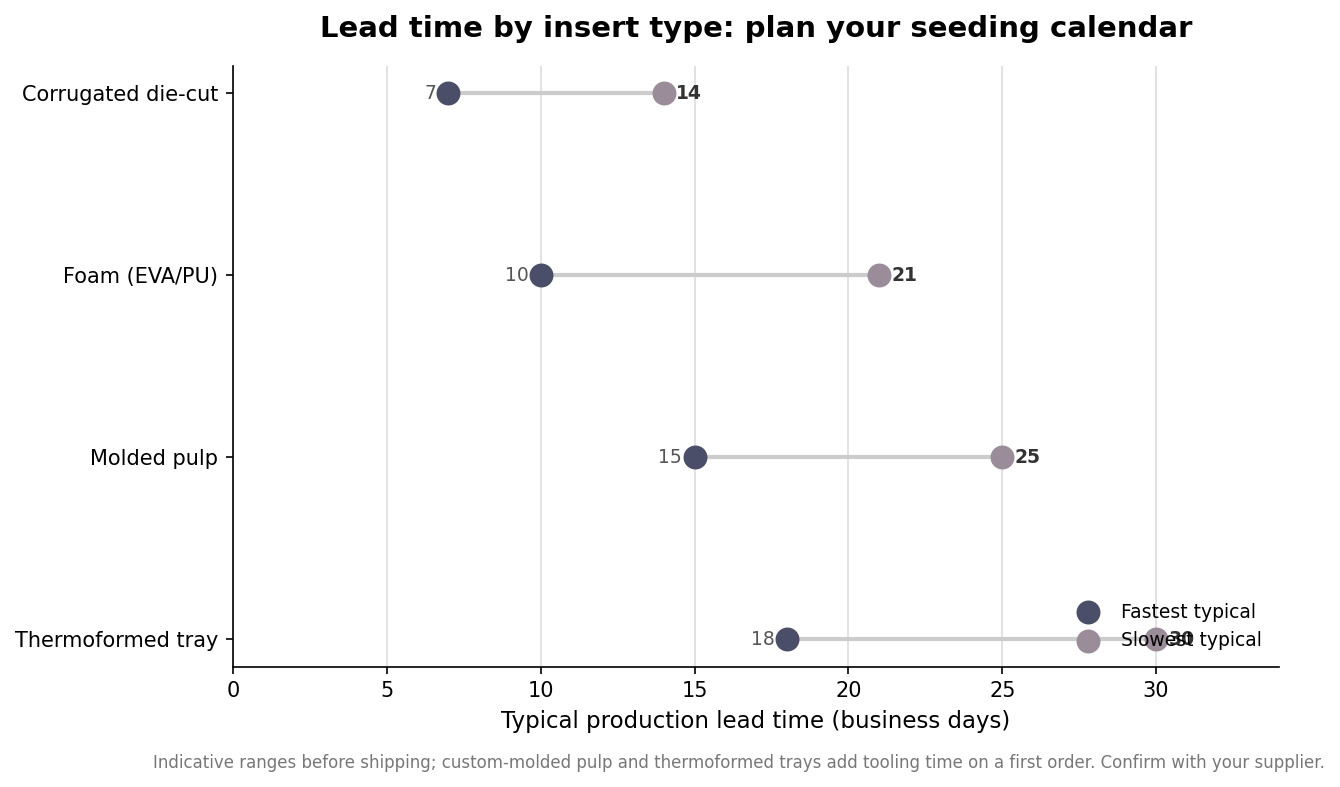
    Dot plot of typical production lead time in business days for corrugated, foam, molded pulp, and thermoformed inserts
    Molded and thermoformed inserts need tooling time, so they must be committed earliest.

    If a product drop has a fixed date, work backwards from it: add production lead time, tooling time on a first order, and transit, and you will usually find that a molded-pulp or thermoformed insert has to be committed weeks earlier than the outer box. The common failure is approving a beautiful pulp cavity too late and shipping the first wave in corrugated as a fallback, which is a fine outcome only if you planned for it. Decide the insert early, because it drives the schedule more than the lid does.

    Choosing for a PR box specifically

    For a durable multi-item kit, corrugated dividers give you the most branding for the least money and the cleanest recyclability story. For a single hero product where the unboxing is the whole point and the brand is eco-positioned, molded pulp is usually the best balance of protection, presentation, and curbside disposal. Save foam for the rare genuinely breakable item, and reserve thermoformed trays for large, glossy launches where volume justifies the tooling and recyclability is not part of the pitch. In every case, prototype the insert with the actual product before you commit the mold, because the cheapest lesson is the one you learn on a sample rather than on a thousand boxes going out to creators.
  • Right-Sizing Your Influencer Box: The Insert and the Shipping Bill

    Right-Sizing Your Influencer Box: The Insert and the Shipping Bill

    A PR box has two quiet ways to fail that have nothing to do with the logo on the lid: it can arrive rattling and dented, or it can cost far more to ship than the product inside is worth. Both trace back to the same overlooked spec — how big the box is and what holds the product in place. Brands pour attention into foil and color and then default to an off-the-shelf box that is an inch too big in every direction, and pay for that inch on every single mailer. Getting the size and the insert right is the difference between an unboxing that lands and a campaign that leaks money on freight and breakage.

    Carriers bill you for the air in the box

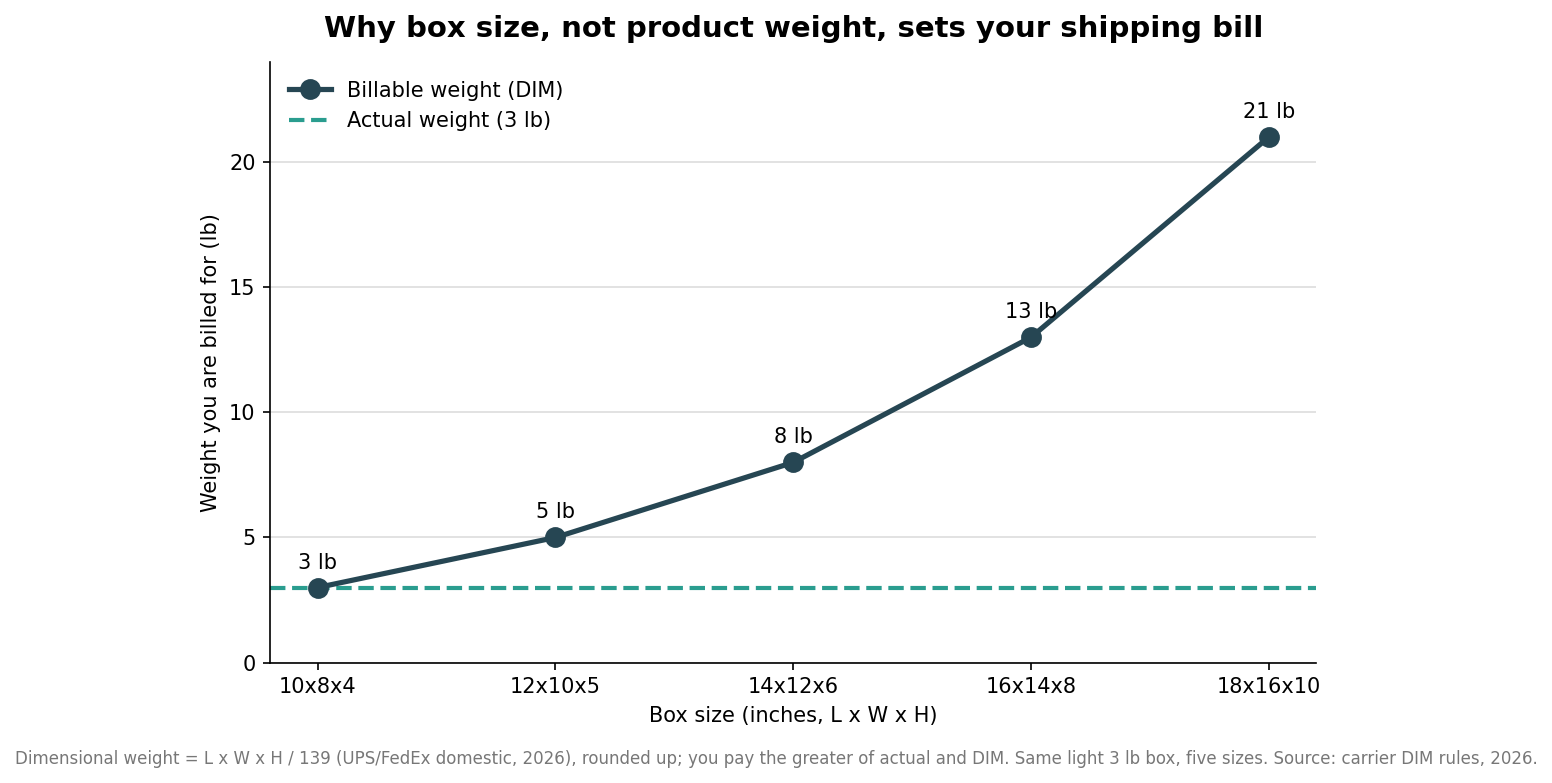
    Shipping is not priced on weight alone. UPS and FedEx bill on dimensional weight, and for domestic parcels in 2026 the formula is length times width times height divided by a divisor of 139, with every fractional inch rounded up to the next whole inch before the math is done. Your invoice uses whichever is larger, the actual scale weight or that dimensional figure. The gap can be brutal: a light 7-pound box measuring 24 by 18 by 12 inches works out to 5,184 cubic inches, which divided by 139 and rounded up is 38 pounds — so you are billed for 38 pounds to ship 7, roughly a 440 percent penalty for empty space. Influencer boxes are usually light and pretty, which is exactly the profile that gets punished by dimensional weight. The cardboard is not heavy; the volume is what you are paying for.

    Line chart showing billable dimensional weight climbing with box size for a constant light 3 pound PR box
    For a light PR box, box dimensions, not product weight, decide the billable weight you pay for.

    Right-size the box before you decorate it

    The fix is unglamorous and highly effective: size the box to the product plus its protection and nothing more. Measure the tallest, widest arrangement of what goes inside, add just enough clearance for the insert and a snug fit, and resist rounding up to the next standard size out of habit. A box that is one inch smaller in each dimension can drop you a full billable pound or two per parcel, which compounds fast across a few hundred mailers. Right-sizing also improves the reveal — a product that sits firmly in a fitted box reads as considered and premium, while one swimming in void fill reads as an afterthought. Decide the internal dimensions first, from the product outward, and let the outer box and its artwork follow. Designing the pretty box first and then forcing the product to fit is how brands end up oversized on both cost and impression.

    The insert decides whether it survives — and how it feels

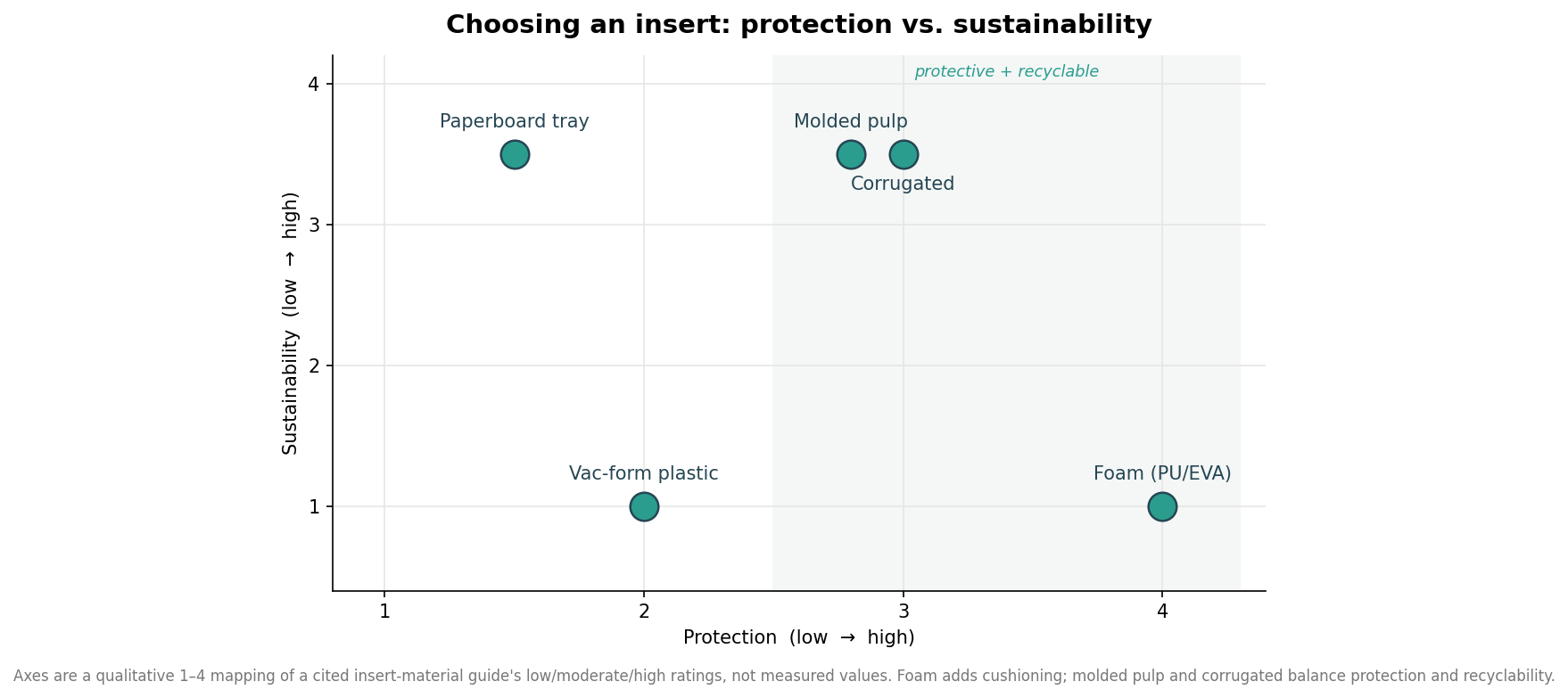
    Once the box is sized, the insert does two jobs at once: it immobilizes the product so it survives transit, and it stages the product so the opening moment works. The common materials trade off protection, presentation, sustainability, and cost differently. Foam inserts (PU or EVA) give the best shock absorption and are the safe choice for glass bottles, serums, and fragile cosmetics, but they are plastic-based and not recyclable. Molded pulp offers a precise, rigid cradle from recycled fiber with strong sustainability credentials, at the cost of a mold fee that only makes sense at volume. Corrugated inserts use fluted cardboard to absorb impact, recycle cleanly, and suit heavier or more fragile items. Paperboard trays look the most premium and print in full color, but offer only light protection and are best for organizing lightweight items rather than shielding them. Vacuum-formed plastic is cheap and moldable but middling on both protection and eco-credentials.

    Scatter quadrant of box insert materials plotted by protection versus sustainability
    Insert materials mapped by protection and sustainability; corrugated and molded pulp balance both.

    Match the insert to the product and the brand story

    Let the contents and the brand’s values pick the material. A single glass fragrance bottle or a breakable compact wants foam or a well-designed molded-pulp cradle that holds it away from the walls. A set of light, unbreakable items — sachets, a printed card, a soft good — is better served by a printed paperboard tray that turns the interior into part of the design. Anything heavy, or anything that will see rough handling on its way to a creator’s doorstep, benefits from corrugated’s impact resistance. And a sustainability-forward beauty or wellness brand should lean toward molded pulp or corrugated, because a plastic foam insert undercuts the exact message an eco-conscious PR box is trying to send. Remember that molded pulp and custom foam carry one-time tooling or mold costs; those amortize well over a few hundred units but can dominate the budget on a tiny run, so weigh the insert choice against how many boxes you are actually sending.

    Test the packed box, not the empty one

    The last step protects both the product and the P&L, and almost nobody does it: pack a real sample exactly as it will ship, seal it, and put it through the trip. Ship one to yourself across the country and see how it arrives, and while you have it, run the dimensional-weight math on the final packed dimensions before you commit to a size. A ten-minute drop test and a quick DIM calculation on a single sample catch the two failures — breakage and freight surprise — that otherwise reveal themselves only after you have printed and packed the entire run. Build the box from the product outward, choose the insert for the contents rather than the catalog, and confirm both with one packed sample, and the campaign spends its budget on the moment the creator opens the lid rather than on air and apologies.

  • Influencer Box Mistakes That Flatten the Unboxing Experience

    Influencer Box Mistakes That Flatten the Unboxing Experience

    An influencer box has one job that a shelf product never has to do: it has to perform on camera. The reveal is the advertisement, and the box is a prop in a video that thousands of people may watch. That changes what “good packaging” means, and it is why boxes that would be perfectly fine in a warehouse fall flat in a creator’s hands. Most of the damage comes from a short list of avoidable mistakes. Here are the ones worth designing against before you commit to a run.

    Sizing the box for the product, not the reveal

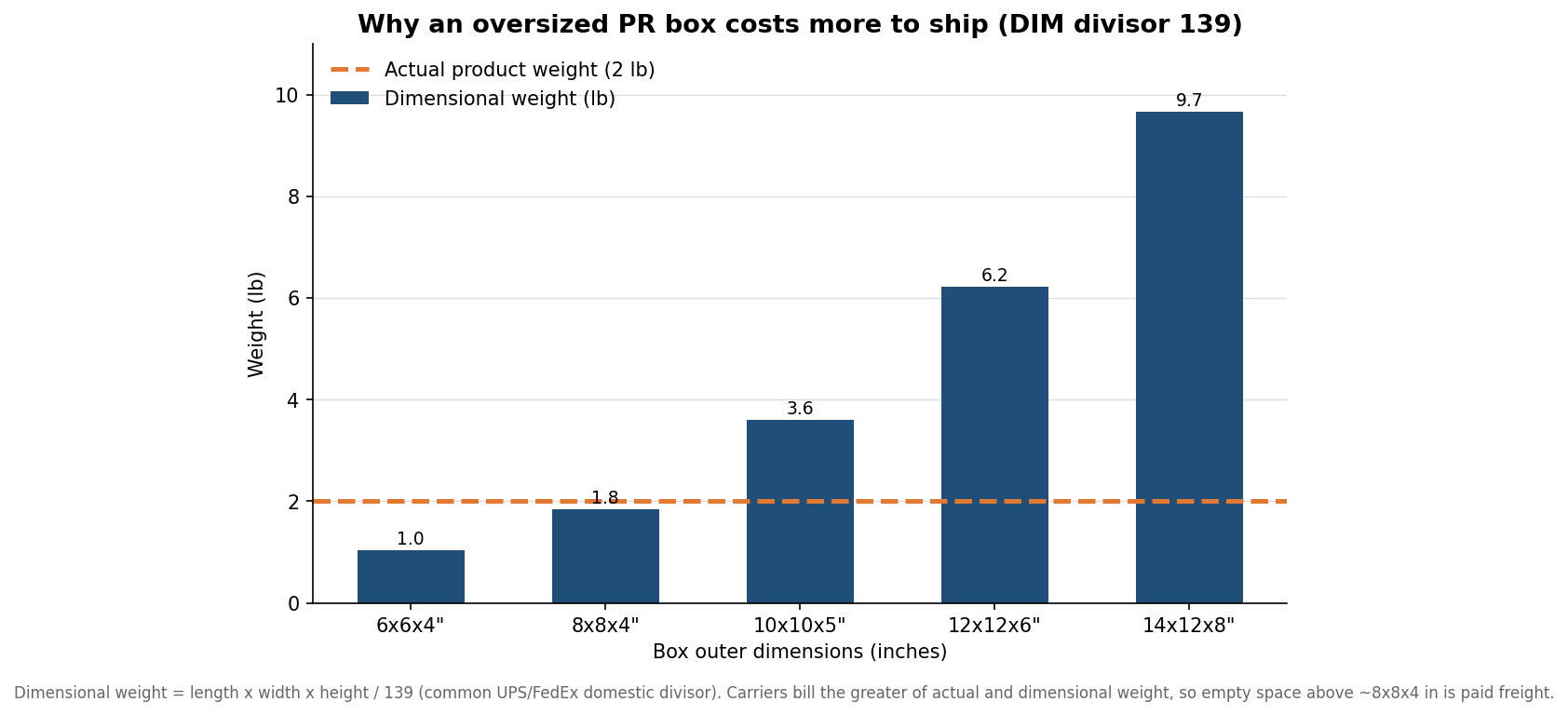
    The most common error is a box that is too big. A roomy box feels safe, but on camera the extra space reads as emptiness, the product slides around, and the reveal loses its sense of occasion. Oversizing also quietly inflates your shipping bill. Carriers charge on dimensional weight, calculated as length times width times height divided by 139 for common domestic UPS and FedEx services, and they bill the greater of actual and dimensional weight. That means air inside an oversized box is freight you pay for.

    Bar chart of dimensional weight rising with box size versus a flat actual product weight line, using the 139 divisor
    Because carriers bill the greater of actual and dimensional weight, an oversized PR box pays freight on empty air.

    As the chart shows, a light product in a 12 by 12 by 6 inch box can be billed at more than three times its real weight. Size the box to the product with just enough room for a protective insert and a reveal layer, and you fix the on-camera problem and the shipping problem at the same time. When in doubt, prototype with the actual product inside before ordering, not a stand-in.

    Treating void fill as an afterthought

    Void fill is what the camera sees first when the lid comes off, so it is a design decision, not a packing-line default. Loose fill and plastic packing peanuts read as cheap and photograph badly, and they scatter the moment a creator tips the box. Custom inserts that cradle each item, molded pulp trays, and neatly folded tissue or crinkle paper all do the opposite: they hold the product still, protect it in transit, and frame the reveal. If the products are fragile, the insert is also your main protection, so it has to be engineered for the trip, not just the photo.

    There is a sustainability angle here too. Plastic void fill is increasingly a bad look on camera for beauty and lifestyle brands, and creators sometimes call it out. Paper-based crinkle fill, molded pulp, and recyclable inserts keep the unboxing on-brand for an audience that notices these things.

    Flattening the reveal into a single layer

    A memorable unboxing has a sequence: the outer mailer, then the branded box, then a layer that has to be lifted or moved, then the product, then a personal touch. Dumping everything into one open tray removes the pacing that makes a reveal watchable. Layered reveals, a magnetic-closure rigid box that opens like a book, or a drawer-style box that slides out all buy you a beat of anticipation. You do not need every trick; you need one or two deliberate moments rather than a flat, everything-at-once presentation. A simple, reliable structure is a rigid box with a lift-off lid, a printed tissue layer, then the hero product seated in an insert with the smaller items tucked beneath. That gives a creator a natural three-beat reveal without any complicated mechanics that might jam or arrive damaged.

    Personalization is the layer brands skip most often and regret most. A pre-printed card with a handwritten signature, the creator’s name on an insert, or variable-data printing that swaps the name and message per recipient turns a generic mailer into something a creator is far more likely to film and mention. It is inexpensive relative to the box itself and it is the single clearest signal that the send was not a bulk blast.

    Budgeting the box but not the program

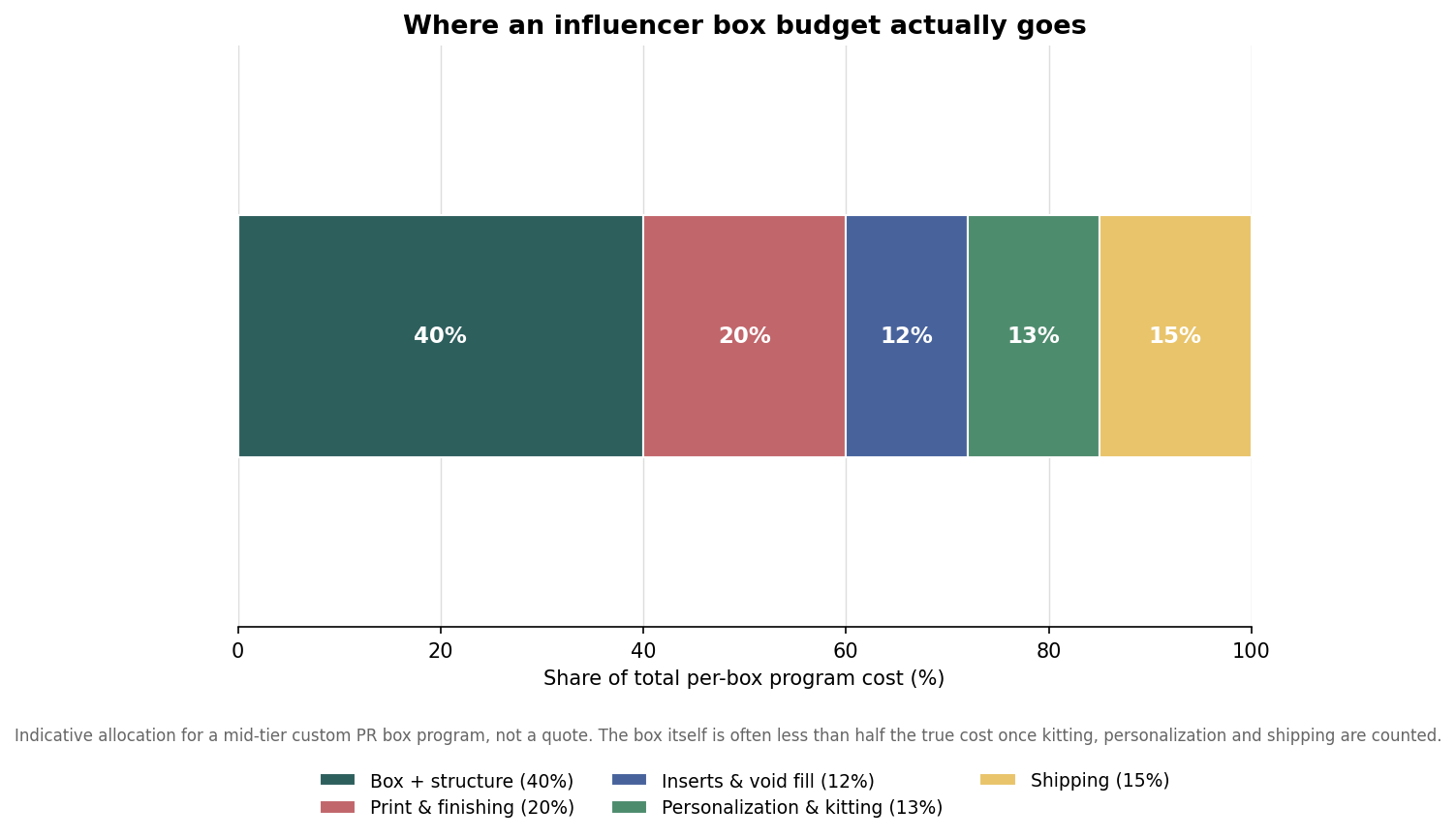
    Many brands price the box and assume they have priced the campaign. They have not. Once you add print and finishing, inserts and void fill, personalization, kitting labor, and shipping, the box itself is often less than half of the true per-unit cost. Underestimating those components is why programs run over budget or get quietly downgraded at the last minute.

    Stacked bar showing indicative influencer box budget split across box, print, inserts, personalization, and shipping
    The printed box is often under half the true per-box cost once inserts, personalization, kitting, and shipping are counted.

    Treat the numbers above as an indicative shape rather than a quote, but use them as a checklist. If your budget only accounts for the printed box, you are missing most of the spend, and the pieces you forget, kitting and shipping, are the ones that scale hardest as your list grows. Build the full per-box cost first, then decide how premium the box can be.

    Getting the finish and the timeline wrong

    Finish matters more on camera than on a shelf because of lighting. High-gloss lamination shows fingerprints and glare under a creator’s ring light, while soft-touch lamination photographs clean and feels premium in hand. Spot UV and foil can add a highlight that catches the light in a good way, but only in moderation; a box that is all shine reflects the room and hides the branding. Test your artwork under bright light, not just on a monitor, because color and contrast shift under studio lighting.

    Finally, respect the calendar. Custom boxes, inserts, and personalization each have their own sourcing lead time, and the slowest component sets your schedule. Brands routinely underestimate this and end up compromising the design to hit a launch date. Lock artwork and components early, order a physical proof, and confirm that lids, inserts, and the product actually fit together before the full run. Avoid these mistakes and the box does what it is there to do: it makes the unboxing worth filming.

  • How Many Influencer Boxes Should You Order?

    Call or Text us: (929) 605-4397

    HomeBlog › How Many Influencer Boxes Should You Order?

    Ordering

    How Many Influencer Boxes Should You Order?

    07/01/2026

    Ordering influencer boxes for the first time, most brands either wildly overestimate a launch wave or badly underestimate a standing ambassador program — and both mistakes cost money. Overordering ties up cash in packaging that sits in a closet; underordering means a rushed reorder at a worse per-unit price right when you need boxes most.

    The good news is the math is simpler than it looks once you separate your program into its actual use cases, because a seeding wave, a launch spike, and a recurring monthly send all follow different logic.

    Start with your program type, not a round number

    Before picking a quantity, sort your need into one of three buckets: a one-time seeding wave (a fixed list of creators for a single campaign), a launch spike (a big first push tied to a release date, followed by a lower steady-state), or a recurring cadence (a fixed monthly or quarterly ambassador send). Each has a different right-sizing approach, and conflating them is the most common ordering mistake we see.

    Seeding waves: count your list, then pad

    If you have a confirmed creator list, add 10–15% for damaged-in-transit replacements, last-minute list additions, and internal team samples. A 200-creator wave becomes a 230-box order. Because our minimum is 100 units, this works cleanly for waves as small as a hundred creators up through several thousand.

    Launch spikes: separate the spike from the baseline

    A product launch typically needs a larger first order (400–1,000+ units depending on your press and creator list) followed by a smaller recurring order once the initial wave settles. Order the launch spike as its own line item rather than trying to size a single order for both the spike and six months of steady state — you’ll get a better per-unit price on each by not averaging the two together.

    Recurring ambassador sends: order in quarters, not months

    If you’re mailing a consistent monthly ambassador box, ordering a full quarter (three months) at once usually beats ordering month to month on price, and gives production enough lead time that a single month’s cadence never gets rushed. A program mailing 50 boxes a month should order roughly 150–175 units per quarter, accounting for a small buffer.

    Program typeHow to size itTypical order
    Seeding waveConfirmed list + 10–15% buffer100–1,000 units
    Launch spikeSize separately from steady-state400–2,000+ units
    Monthly ambassador sendOrder a full quarter at once150–500 units per quarter
    Agency multi-client programCombine volume across clients for pricing500–5,000+ units
    Key takeawaySize a seeding wave off your confirmed list plus a 10–15% buffer, and order a recurring ambassador program by the quarter rather than the month for better pricing and lead time.

    The fastest way to get this right is to tell us your program type when you request a quote — we’ll ask the right follow-up questions and recommend a quantity that fits your budget and your calendar instead of leaving you to guess.

    More posts

  • Foil Stamp vs. Full-Color Print: Choosing a Decoration Method for Your Influencer Box

    Call or Text us: (929) 605-4397

    HomeBlog › Foil Stamp vs. Full-Color Print: Choosing a Decoration Method for Your Influencer Box

    Buyer guides

    Foil Stamp vs. Full-Color Print: Choosing a Decoration Method for Your Influencer Box

    06/17/2026

    The single biggest design decision on any influencer box order isn’t the box style — it’s the decoration method. Foil stamping and full-color printing produce completely different visual results, cost differently, and suit different brand stories, and most brands only need to ask themselves a few questions to land on the right one.

    Neither method is objectively better. The right choice depends on what you’re trying to say with the box before anyone even opens it.

    What foil stamping actually is

    Foil stamping presses a thin layer of metallic or pigmented foil into the board using a heated die, embossing your logo or mark directly into the surface rather than printing on top of it. The result reads as restrained and premium — a single champagne-gold mark on kraft or matte black board photographs beautifully and survives handling far better than a printed logo, because there’s no ink layer to scuff.

    What full-color printing actually is

    Full-color (CMYK) printing lays down unlimited colors across the entire surface of the box, which means photography, gradients, patterns, and full campaign artwork are all possible — things a one- or two-color foil die simply can’t do. It’s the only option if the box itself needs to carry a specific season’s lookbook imagery or a launch campaign’s key art.

    Cost and lead time differences

    Foil dies have an upfront tooling cost but are cheap to reuse on every reorder, which makes foil the more economical choice for a recurring program that reorders the same design repeatedly. Full-color printing has no separate tooling step but a comparable or slightly higher per-unit cost at most volumes, and every new design is effectively a new print run rather than a reused die.

    Matching decoration to program type

    As a rule of thumb: seeding waves and recurring monthly sends favor foil on a locked design, because it reorders fast and cheap once the die exists. Seasonal launches and one-off campaigns favor full-color print, because the artwork changes every time anyway, so there’s no reorder efficiency to lose by using print instead of foil.

    FactorFoil StampingFull-Color Print
    Best forRecurring programs, minimalist brandsSeasonal campaigns, photography-led design
    Color range1–2 colors typicallyUnlimited CMYK
    Reorder costLower once die is cutComparable each run
    Visual feelRestrained, embossed, premiumBold, photographic, campaign-driven
    DurabilityEmbossed into board, very durableDurable with matte/gloss lamination
    Key takeawayChoose foil for a recurring program you’ll reorder often; choose full-color print when the box needs to carry campaign-specific artwork that changes every launch.

    If you’re still not sure, send us a description of your program and we’ll recommend a decoration method as part of your free mockup — there’s no wrong answer, only a better fit for how often you’re reordering and what story the box needs to tell.

    More posts

  • Custom Influencer Boxes for Product Launches

    Call or Text us: (929) 605-4397

    HomeBlog › Custom Influencer Boxes for Product Launches

    Product Launches

    Custom Influencer Boxes for Product Launches

    06/03/2026

    A product launch gets one first impression with each creator on your seeding list, and a generic shipping box with a sticker on it wastes it. The unboxing is content whether you plan for it or not — the only question is whether it’s content that helps your launch or looks like an afterthought.

    Launch packaging has a few requirements that differ from an everyday recurring send, mostly around timing, artwork, and making the box itself feel like a campaign moment rather than routine fulfillment.

    Design the box around the campaign, not the logo alone

    A launch box benefits from campaign-specific artwork — key art, a tagline, a color story tied to the specific product — rather than your evergreen brand box. Full-color printing is usually the right call here because it can carry that one-time artwork without needing a new foil die for a box you may not reorder identically.

    Build in buffer for the unpredictable parts of a launch

    Launch lists grow at the last minute as PR confirms additional creators, and boxes get damaged in transit at a higher rate when they’re timed tightly to a single date rather than shipped on a relaxed schedule. Order at least 15% over your confirmed list, and lock your mockup approval early enough that a 2–3 week production window doesn’t collide with your launch date.

    Sequence the reveal inside the box

    Launch boxes are the place to invest in the reveal sequence — a tissue-lined interior, a printed insert card with launch details, or a two-piece rigid construction that gives an unobstructed shot of the hero product the second the lid comes off. This is the content moment creators are most likely to actually film, so it’s worth the extra production step.

    Coordinate ship dates so the story breaks together

    The value of a launch box is largely lost if boxes arrive on wildly different days and creators post whenever they get around to it. Confirm your quantity and artwork early enough that we can ship the full wave within a tight window, so the campaign has a coordinated moment online instead of a trickle.

    Launch stageWhat to lock inTypical timing
    8–10 weeks outConfirm creator list size and box styleBefore quote
    6–8 weeks outApprove mockup and campaign artwork24–48h turnaround per revision
    3–4 weeks outLock final quantity and payProduction starts same day
    1–2 weeks outConfirm ship window with distribution list2–3 week production
    Key takeawayOrder 15% over your confirmed creator list, lock artwork 6–8 weeks before your launch date, and ship the full wave in a tight window so the campaign breaks online together.

    Ready to plan packaging around a launch date? Get a custom quote and tell us your target date — we’ll work backward from it to confirm what’s realistic. Read more about how we work on our About page, or browse more guides.

    More posts

  • Custom Influencer Boxes for Beauty and Skincare Brands

    Call or Text us: (929) 605-4397

    HomeBlog › Custom Influencer Boxes for Beauty and Skincare Brands

    Beauty & Skincare

    Custom Influencer Boxes for Beauty and Skincare Brands

    05/20/2026

    Beauty and skincare unboxing content lives or dies under close, unforgiving light — a ring light or a macro phone lens will show every seam, every scuff, and every place a print looks like a sticker instead of real decoration. That makes packaging choice more consequential for this category than almost any other on this list.

    Beauty brands also tend to ship a mix of hero and sample sizes in a single box, which affects both interior fit and box style more than category alone.

    Rigid construction reads as premium under close-up filming

    A rigid magnetic or two-piece box holds its shape and shows a clean, unblemished surface on camera in a way corrugated stock sometimes can’t at extreme close range. For flagship press kits featuring a hero serum or a full regimen, rigid construction is worth the marginal cost over a mailer-style box.

    Fit the interior to fragile glass and bottles

    Skincare and beauty products are disproportionately glass, pump bottles, and jars — all of which need a fitted foam insert or firm tissue nest to avoid shifting and cracking in transit, and all of which look better centered and secure in an unboxing shot rather than rattling loose. Tell us your product dimensions and we’ll build the interior around them.

    Sage green and blush pink read as clean and botanical

    Color choice does real signaling work in this category. Sage green and blush pink both photograph as clean, botanical, and gentle — on-brand language for most skincare positioning — while matte black and champagne foil skew toward a more luxury, editorial beauty story. Pick the palette that matches your product’s actual formulation story, not just what looks nice.

    Sample and sachet waves need their own box style

    Beauty brands running large micro-influencer seeding waves for a sample-size product shouldn’t use the same rigid box priced for a hero-product press kit — the economics don’t work at that scale. A smaller, still-branded mini box keeps a large wave affordable while still giving every recipient a considered unboxing moment.

    Beauty use caseRecommended styleWhy
    Flagship press kitRigid Magnetic Closure BoxHolds shape and finish under macro-lens filming
    Full regimen / multi-SKU setTwo-Piece Rigid Lid & Base BoxFoam insert keeps multiple bottles secure and centered
    Sample / sachet seeding waveMini Sample & Sachet BoxAffordable at hundreds or thousands of units
    Recurring subscription sendFoil-Stamped Kraft Mailer BoxConsistent, reorders fast on a locked die
    Key takeawayMatch rigid construction to hero-product press kits, fit interiors to glass and bottles with foam or tissue, and use a smaller mini box for large sample-seeding waves rather than scaling a full-size box down in price.

    Building a beauty or skincare press kit? Get a custom quote and tell us your product mix — we’ll recommend a style and interior fit. See our full product lineup or read more guides.

    More posts

  • Rigid Box vs. Kraft Mailer: Which Influencer Box Lasts Through Shipping?

    Call or Text us: (929) 605-4397

    HomeBlog › Rigid Box vs. Kraft Mailer: Which Influencer Box Lasts Through Shipping?

    Buyer guides

    Rigid Box vs. Kraft Mailer: Which Influencer Box Lasts Through Shipping?

    05/06/2026

    Every influencer box has to survive a truck, a sorting facility, and a front porch before anyone films the unboxing — and rigid chipboard and premium corrugated kraft handle that journey differently. Picking the wrong one for your volume and distance can mean a wave of dented boxes arriving right when you need a clean first impression most.

    This isn’t really a question of which material is “better” in the abstract. It’s a question of which tradeoffs match your shipping distances, your budget, and how precious the specific decoration on your box is.

    Rigid chipboard: maximum protection, higher cost

    2mm rigid chipboard resists crushing and corner damage better than any other material we offer, which matters most for long-distance and international shipments where a box passes through more handling points. It’s also the material that best preserves foil stamping and spot UV finishes, since a rigid, flat surface is what those decoration methods need to look their sharpest.

    Premium corrugated kraft: flexible, ships flat, lower cost

    E-flute corrugated kraft mailer stock has genuine give under pressure rather than resisting it outright, which sounds worse but actually means it distributes impact rather than denting sharply at a single point. Combined with a lower material cost and the ability to ship flat before assembly, it’s the more economical choice for high-volume domestic sends where individual box cost matters more than maximum crush resistance.

    Distance and volume should drive the decision

    For flagship, low-volume press kits shipping any real distance, rigid construction is worth the added cost because the box itself is part of the gift. For high-volume domestic seeding waves where hundreds or thousands of units ship regionally, premium kraft mailer stock holds up fine and keeps per-unit cost proportional to the volume.

    Both materials take foil and print well

    Neither choice limits your decoration options meaningfully — both take foil stamping, full-color printing, and matte lamination. The real durability difference shows up in transit, not on the shelf, so weigh your actual shipping profile rather than assuming rigid is always the safer call.

    FactorRigid ChipboardPremium Corrugated Kraft
    Crush resistanceHighestModerate, absorbs impact
    Cost per unitHigherLower
    Best shipping distanceLong-distance / internationalRegional / domestic
    Ships flat before assemblyNo, pre-assembledYes
    Best decoration pairingFoil stamp, spot UVFoil stamp, single-color print
    Key takeawayChoose rigid chipboard for flagship, long-distance press kits where the box itself is part of the gift; choose premium corrugated kraft for high-volume domestic seeding waves where per-unit cost matters most.

    Not sure which material fits your shipping profile? Get a custom quote and tell us your typical ship distance and volume — we’ll recommend a material as part of your mockup. Browse all styles or read more guides.

    More posts

  • Custom Influencer Boxes for Fashion and Apparel Brands

    Call or Text us: (929) 605-4397

    HomeBlog › Custom Influencer Boxes for Fashion and Apparel Brands

    Fashion & Apparel

    Custom Influencer Boxes for Fashion and Apparel Brands

    04/22/2026

    Fashion and apparel unboxing content is built around a single clean reveal shot — the moment a lid clears the base and the folded garment or accessory comes into frame with nothing obstructing it. That specific moment drives more of the box design decision for this category than color, print, or finish.

    Because apparel brands also refresh their visual identity every season, packaging needs to flex between drops without a full retool each time.

    Why the two-piece silhouette wins for apparel

    A telescoping lid-and-base construction, where the lid lifts completely free rather than hinging open, gives an unobstructed shot the instant it clears the base — no hinge or flap crosses the frame the way it does on a book-style box. For folded apparel, scarves, or accessories laid flat inside, that clean separation is what makes the unboxing shot look like a lookbook photo rather than a shipping video.

    Season-to-season flexibility without new tooling

    Because the lid and base are separate rigid components, they can be finished differently — a foil-stamped black lid over a kraft base for one drop, a full-color printed base under a clean white lid for the next — without redesigning the whole box. This lets a seasonal collection get its own visual identity on packaging without a full new tooling cost each time.

    Color story should track the collection, not just the house brand

    Apparel brands get more mileage out of full-color printing than most categories, because a specific season’s lookbook palette or campaign photography can wrap the box itself. A locked foil logo works fine for an evergreen house box, but a seasonal drop usually benefits from artwork that visually matches that specific collection.

    Interior lining protects fabric, not just glass

    Unlike beauty products, apparel doesn’t need a rigid foam insert so much as a soft tissue lining that prevents creasing and keeps folded garments from shifting during transit. A branded tissue wrap in a seasonal color also adds a second design layer before the garment itself is visible.

    Apparel scenarioRecommended approachWhy
    Seasonal capsule dropTwo-Piece Rigid Box, full-color printedCarries season-specific artwork without new tooling
    Evergreen house boxTwo-Piece Rigid Box, foil-stamped lidReorders fast on a locked design
    Accessory or footwear samplesTwo-Piece Rigid Box + foam insertKeeps hard goods fixed during shoot handling
    Folded apparel / soft goodsTissue-Lined Gift BoxPrevents creasing, softer reveal
    Key takeawayThe two-piece rigid box’s fully separating lid gives the unobstructed reveal shot apparel content depends on, and different lid/base finishes let a seasonal drop get its own look without new tooling.

    Planning packaging for a seasonal drop? Get a custom quote and tell us your collection timeline — we’ll recommend a finish approach. See the Two-Piece Rigid Box or browse more guides.

    More posts

  • An Agency’s Guide to Running Multi-Client PR Mailers

    Call or Text us: (929) 605-4397

    HomeBlog › An Agency’s Guide to Running Multi-Client PR Mailers

    Agencies

    An Agency’s Guide to Running Multi-Client PR Mailers

    04/08/2026

    Agencies and PR firms don’t just order more influencer boxes than a single brand — they order differently, juggling several client accounts each with its own artwork, timeline, and budget tier, often in the same production week. Without a system, that complexity turns into missed deadlines and mixed-up shipments.

    The agencies who run this smoothly tend to follow a few consistent practices, regardless of how many client accounts they’re managing at once.

    Keep client artwork and specs on file, not in your inbox

    The single biggest time sink in multi-client packaging is re-explaining a client’s brand colors and logo files on every reorder. We keep artwork, box colors, and die-line specs on file per client account, so a reorder for Client B doesn’t require digging through six-month-old email threads.

    Standardize box style across clients where the brand allows it

    Not every client needs a bespoke box style — many are happy with a standard rigid or kraft mailer style differentiated only by finish and color. Standardizing the base style across multiple client accounts, even while varying the decoration, simplifies production scheduling and can improve pricing through combined volume.

    Stagger production requests instead of batching them all at once

    Submitting five client quote requests in the same hour doesn’t get any of them mocked up faster — it just means five 24–48 hour mockup clocks all start at once and compete for the same review time on your end. Staggering requests by a day or two, when your calendar allows it, generally gets each client’s mockup back to you faster.

    Combine volume across clients for better pricing tiers

    Because pricing improves with quantity, an agency ordering 300 units apiece for four different clients in the same production window can sometimes hit a better combined price tier than four completely separate 300-unit orders placed months apart. Ask us to quote combined volume when your client calendar allows it.

    Agency practiceBenefit
    Keep specs on file per clientFaster reorders, no re-explaining brand assets
    Standardize base box style across clientsSimpler production scheduling, potential combined pricing
    Stagger quote requestsFaster individual mockup turnaround
    Combine volume across active clientsBetter per-unit pricing tier
    Key takeawayStandardize base box styles across client accounts where possible, keep specs on file per client, and combine volume across active campaigns to reach better pricing tiers.

    Running packaging for multiple client accounts? Get a custom quote and tell us you’re an agency — we’ll set up your account to track specs per client. Read more about how we work or browse more guides.

    More posts