Everything a brand agonizes over on the outside of an influencer box, the foil, the color, the magnetic closure, is undone in half a second if the creator opens the lid to find the product rattling loose in a nest of shredded paper. The insert is the part of the box that does the quiet work: it holds the product still through a rough courier network and it stages the reveal for a camera that is already rolling. Those are two different jobs, and the four common insert materials trade them off very differently. Here is how they compare when the box is a PR or seeding unit rather than a shipping carton.
The insert has two jobs, not one
A retail shipping insert only has to get the product there intact. A PR insert has to do that and land the first impression, because the moment the box opens is the content. That raises the bar on presentation, on how the product is angled toward the opener, and on whether the interior reads as considered or cheap. It also raises the stakes on protection, because a cracked compact or a leaking serum photographs terribly and quietly kills the post you paid to seed. Pick the material that satisfies whichever of those two jobs is your real constraint, then make it acceptable on the other.
Corrugated die-cut: the printable workhorse
Die-cut corrugated inserts, cell dividers, pads, and cradles are the most economical option and the easiest to brand, since corrugated takes print well and can carry color or a message on the insert itself. The tradeoff is that corrugated holds and organizes rather than cushions. It is excellent for kitting several items into fixed positions and for keeping a flat-lay looking intentional, but it is not a shock-absorber for anything genuinely fragile. Lead times are short, commonly in the range of seven to fourteen business days, and it is fully curbside recyclable, which makes it the default for multi-item seeding kits of durable goods.
Molded pulp: the sustainable presentation choice
Molded pulp, or molded fiber, forms a custom cavity around each item from what is typically 100% recycled paper. It comes in grades from rough thick-wall through transfer-molded and thermoformed versions with one or both faces smooth, so you can choose how refined the finish looks. It cushions better than flat corrugated, it is curbside recyclable and compostable, and it has become the standard swap for brands trying to get plastic and foam out of a box. The two costs to plan for are a mold, which adds upfront tooling and pushes first-order lead times into the three-to-five-week range, and surface texture, which limits high-definition printing on the insert. The chart below places it against the alternatives on the two axes that usually decide a PR box.
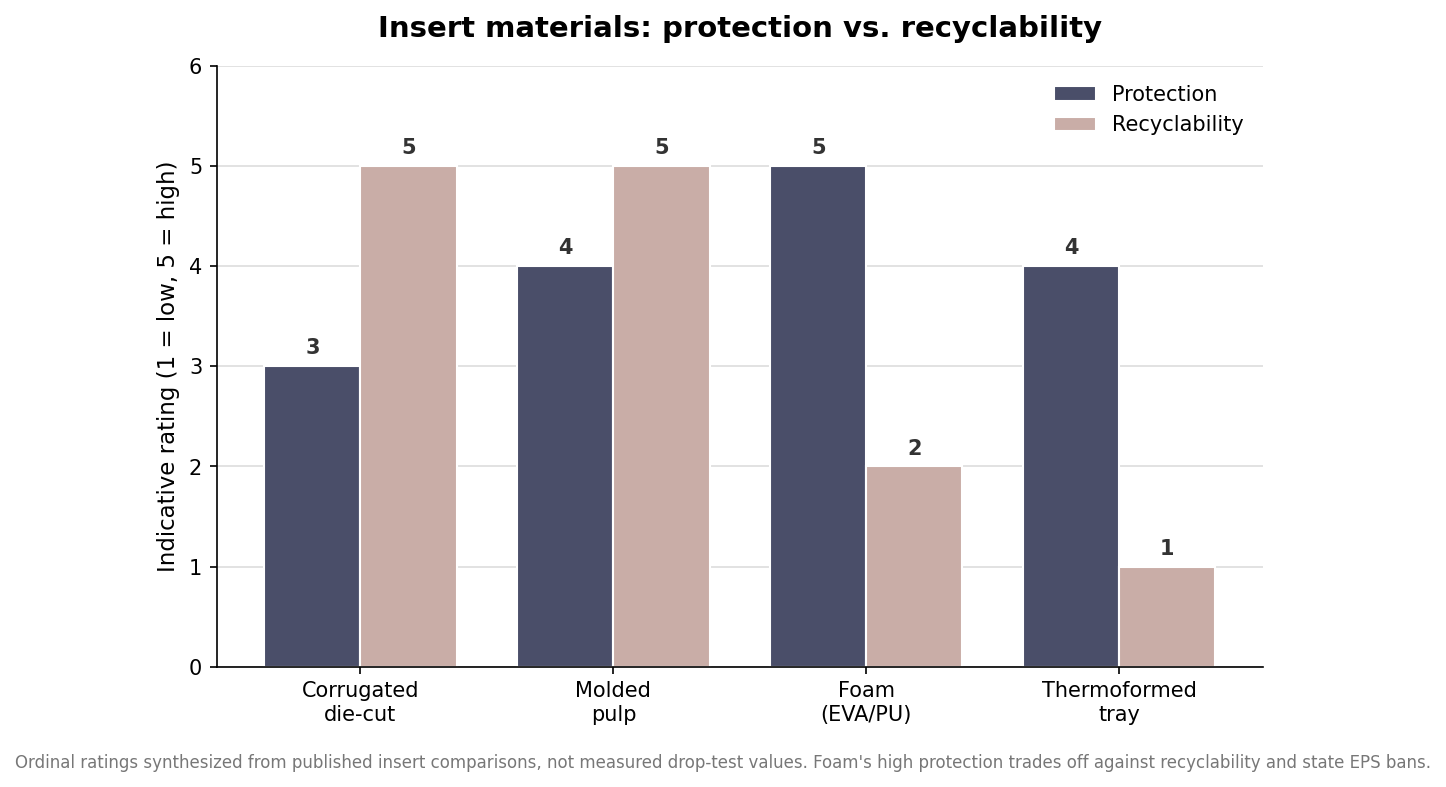
As an indicative figure, custom molded-pulp inserts often land around a dollar per unit at retail-facing volumes, though real pricing swings with cavity complexity and quantity, so treat that as a planning number and get a volume quote.
Foam: maximum protection, minimum print
Die-cut foam, whether flexible EPE, rigid EPS, or precision polyurethane, wins outright on shock absorption and is the right answer for genuinely fragile or high-value electronics. For an influencer box it carries three real drawbacks. Foam prints poorly, so it rarely looks premium on camera unless it is hidden under a tray. It adds bulk that increases dimensional-weight shipping charges. And expanded polystyrene in particular is now banned from disposal in several states, including California and New York, which turns a foam insert into a sustainability liability that beauty and lifestyle brands increasingly cannot defend. Reach for foam when the product will genuinely break otherwise, not by default.
Thermoformed trays: the retail-slick option
A thermoformed plastic tray gives the crisp, product-hugging look of premium electronics or cosmetics packaging and holds items dead still. It suits high-volume runs because the tooling cost is significant and only amortizes across large quantities, and its lead times sit alongside or beyond molded pulp. The catch is recyclability: most thermoformed trays are not curbside accepted, so the same tray that looks the most expensive is often the hardest to square with a sustainability message. It is a strong choice for a large, polished launch and a poor one for a small eco-positioned seeding wave.
Match lead time to your seeding calendar
The material you can afford is often less of a constraint than the calendar. Corrugated can turn around inside two weeks; anything molded, whether pulp or thermoformed plastic, needs tooling built before the first unit exists, and that step is where launch timelines slip.
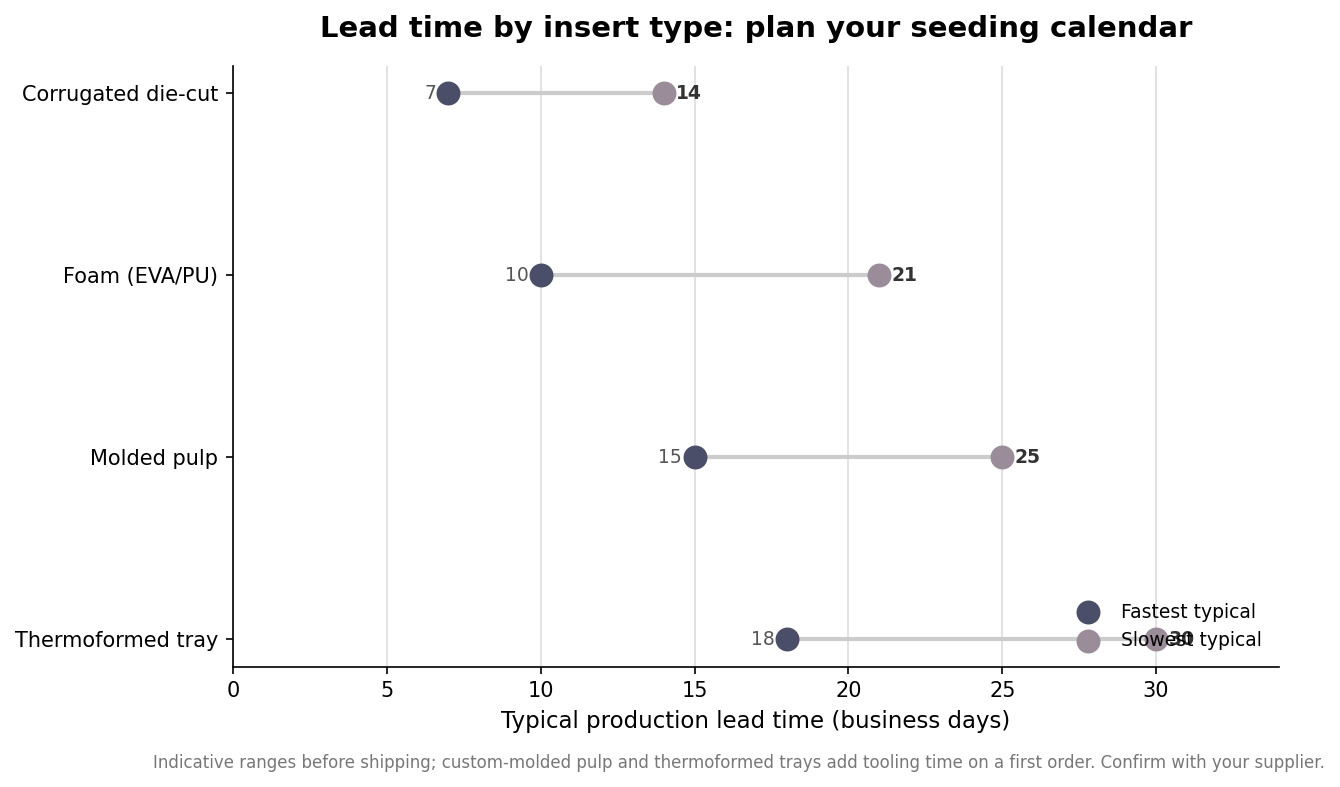
If a product drop has a fixed date, work backwards from it: add production lead time, tooling time on a first order, and transit, and you will usually find that a molded-pulp or thermoformed insert has to be committed weeks earlier than the outer box. The common failure is approving a beautiful pulp cavity too late and shipping the first wave in corrugated as a fallback, which is a fine outcome only if you planned for it. Decide the insert early, because it drives the schedule more than the lid does.
Choosing for a PR box specifically
For a durable multi-item kit, corrugated dividers give you the most branding for the least money and the cleanest recyclability story. For a single hero product where the unboxing is the whole point and the brand is eco-positioned, molded pulp is usually the best balance of protection, presentation, and curbside disposal. Save foam for the rare genuinely breakable item, and reserve thermoformed trays for large, glossy launches where volume justifies the tooling and recyclability is not part of the pitch. In every case, prototype the insert with the actual product before you commit the mold, because the cheapest lesson is the one you learn on a sample rather than on a thousand boxes going out to creators.
Leave a Reply